 3 hours ago
Faren TaghizadehBBC Persian

 NurPhoto / Getty Images
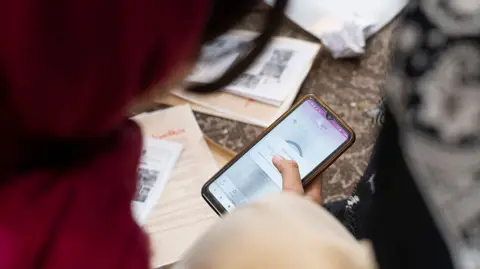
Iranians have been figuring out how to bypass wartime restrictions on the internet and phone network (file photo from 2025)
On the Iran-Turkey border a man sells a service that helps Iranians outside their country keep in touch with loved ones inside.
His secret is two phones - one connected to the Iranian phone network and one to the Turkish. It's necessary because international calls into Iran are blocked.
Customers outside Iran call his Turkish phone on WhatsApp and he then dials their loved ones on his Iranian mobile.
He holds the two together so people desperate to hear from their families inside Iran can speak to them.
As he's on the border, the man can connect to both the Turkish and Iranian mobile networks at the same time.
It is one of the ways Iranians are circumventing the blocks on internet and phone connections authorities have put in place during the war with the US and Israel - but these services are expensive and patchy.
Calling abroad rarely works the first time and calls usually last two or three minutes before cutting out.
And BBC Persian has found that, with money transfer fees, it costs about £28 ($38) for a four- or five-minute call.
But customers feel it's a price worth paying.
Ava (whose name, like the other people quoted in this article, has been changed) was due to get married this week. Her fiance lives in Canada and was due to fly to Tehran for the ceremony before the war brought air travel to an abrupt halt.
"I'm paying a huge amount of money to be able to connect to the internet to talk to him right now," she says.
Hamid also lives in Tehran and has been desperate to find ways to keep in touch with his wife and other relatives abroad.
"In these past days I tried everything just to connect," he says. "The cost didn't matter to me, even though it was a financial burden. I just wanted them to feel a little calmer."
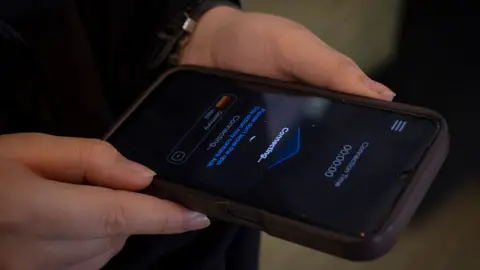
He's been using a virtual private network (VPN), which can bypass the restrictions the Iranian authorities have put on the internet, allowing people to message and call abroad.
 NurPhoto / Getty Images
VPN apps offer one way to get around restrictions (file photo from 2025)
Hamid says the cost of VPNs has "skyrocketed" to around £15 ($20) for a gigabyte of data - a considerable amount given the monthly minimum wage in Iran is only $100 - and that the connection was still "extremely unstable".
If the connection cuts out while he is using the VPN, he adds, the data he has bought is gone and cannot be refunded.
"Whenever I managed to connect to the internet, even briefly, I would message everyone and ask them to send me their families' phone numbers so I could check on them and send news back," he says.
"When I call a mother and mention the name of the child who asked about her, the sound of her laughter and excitement changes my whole world."
Negar, who lives in Toronto, Canada, says her family have been managing to make short calls to reassure her they are okay, knowing how anxious she was during the deadly anti-government protests in Iran in January. These have done little to allay her worries.
"The worst part of the story is that they are under heavy bombardment, yet they call me and say: 'We're fine, don't worry about us.' That is what is killing me."
Shadi lives in Melbourne, in Australia, but her parents' home is in a neighbourhood of Tehran known as "the hornet's nest". It's close to a major oil depot hit on 7 March and other sensitive sites such as the Ministry of Defence.
They, too, gather news from relatives and neighbours so it can be passed on to family abroad when they are able to connect, she says.
Shadi says her father has stopped going for walks after "black rain" fell on him following the nearby oil depot strike.
 NurPhoto / Getty Images
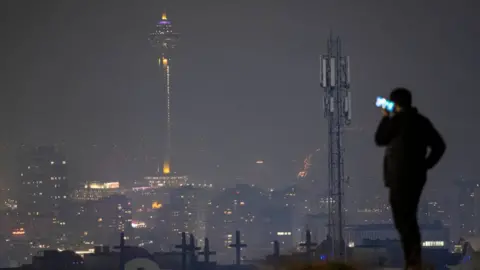
A man in Tehran using his phone on a hill overlooking the Milad telecommunications tower (file photo from 2024)
Zahra lives in Europe and is anxiously staying in touch with her brother in Iran, who uses a VPN to access Telegram.
"If he goes offline for more than half an hour or an hour, all kinds of frightening thoughts start running through my mind," she says.
Her brother said her family rarely leaves the house given the "terrifying" sounds of fighter jets and explosions.
She recalls him saying: "Outside, there are also patrols everywhere, standing at every intersection, staring into your eyes. If they don't like the way you look, they stop you."
Being able to work across different platforms and use technical tricks to evade the restrictions has made it hard for less tech-savvy relatives to stay in touch.
The only person Pooneh, who lives in London, can contact is her sister - "maybe because she is more comfortable with technology and finds ways to make the call", she explains.
"I can't call [my family]," Pooneh adds. "Even this simple thing creates a strange feeling, as if nothing is in my control."
Like many, she and her sister have a two-way exchange, the person inside Iran passing on family messages and the one abroad giving updates about the war not available in Iran due to government censorship.
"It feels as if each of us is missing part of the story, and we have to piece it together through each other."
Additional reporting by the BBC Persian team